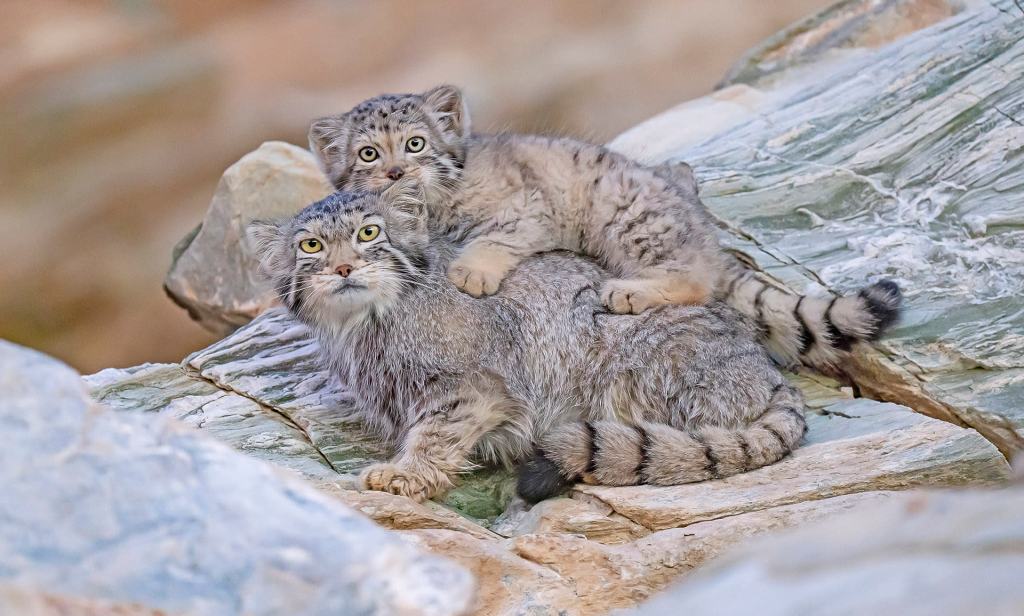
The Pallas’s cat, sometimes known as the “grumpy cat,” is one of the most interesting small wild cat species. You will often see these cats on social media, and unlike the last two species I covered, this one is a bit more well known. Even so, I had never really done a deep dive on this amazing and very adorable cat until now. Although they are roughly the size and weight of a large house cat, hopefully by the end of this you will have a newfound respect for this special species.
The Pallas’s cat lives in a very harsh climate. You can find it across Central Asia in places like Mongolia, as well as in the steppes and mountainous regions stretching through China and Nepal. This cat has to endure dramatic seasonal changes, with summers that can climb over 100 degrees and winters that can fall far below zero, sometimes reaching as low as -40. To survive this, the cat builds up fat in preparation for the harsh winter months and grows an incredibly dense fur coat, which is believed to be the densest of any cat species. During the summer, it sheds much of that fur and loses some of the fat gained during winter so it can better handle the long, grueling warmer months. In the Mongolian steppe, it must also endure long dry seasons before the rains of the warmer months arrive.
On the steppe, the Pallas’s cat has to contend with predators such as eagles, foxes, and dogs. To survive, it has some remarkable adaptations. Since there are no trees across much of its habitat, one of its main survival strategies is to stay low and remain perfectly still against the ground. Its round body, rounded head, and low-set ears help it resemble a small rock or boulder from a bird’s-eye view or from far away across the plains. When this cat decides to stay still, it can remain motionless for hours until it decides the area is safe. Another way it protects itself is by hiding in the many crevices among rocks and boulder formations across the plains. These hidden places are often where it spends much of its time resting and staying safe, while it hunts primarily at dawn and dusk.
Its favorite prey is the pika, a small mammal that is an important food source across much of its range, though it also eats other small mammals, birds, and insects. In such a harsh environment, it cannot afford to be careless and must take advantage of every hunting opportunity. The Pallas’s cat is an ambush predator, and it has several traits that help it hunt this way. As mentioned before, it can sit perfectly still for hours and look like nothing more than a small rock. During the warmer and wetter months, its coat can become more yellowish than it is in winter, helping it blend into dry grasses as it stalks prey across the plains. Since it spends so much time among rocks and boulders for safety, this also benefits its hunting, as many of the small animals it preys on use the same terrain for shelter from predators and the harsh climate.
The Pallas’s cat lives a mostly solitary life and generally only interacts with others during breeding season. Kittens mature very quickly, and they need to, because surviving that first winter can be extremely difficult. They are often born in late winter or early spring, hidden deep within rock crevices or other sheltered places.
One last especially interesting thing about the Pallas’s cat is its rounded pupils. Many ambush hunters have vertically slit pupils, so the rounded eyes of the Pallas’s cat are quite unusual given its hunting style.
I truly hope and pray that one day I will have the chance to see this cat in the wild. Hopefully you’ve enjoyed this series and learned something new, especially about the remarkable Pallas’s cat.
Coming soon is a letter that I may or may not publish. It might be one of those things that’s better written in a notebook but I am still unsure. It is done and ready so depending on my choice that could be next. I’m also considering some pieces on African nations next. Such a rich history/geography I’m sure it would be fun to do some deep dives.
 Between Maps and Meaning
Leave a comment