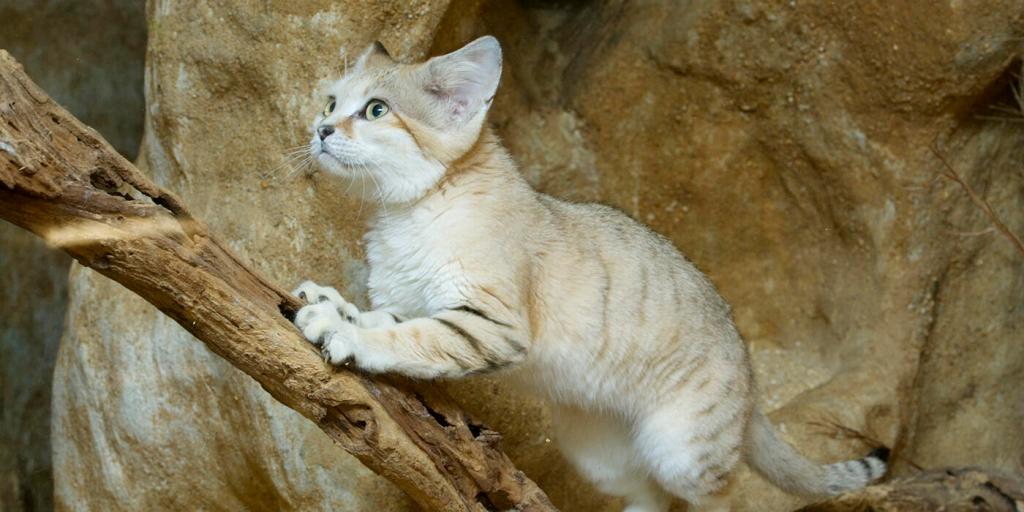
The Sand Cat was one of the most fun little creatures to learn about. As you can see, they are incredibly cute — but these cats are tough. They survive in some of the harshest environments on Earth. Although only about the size of a small house cat (3 lb to 7 lb), they have unique adaptations that truly set them apart.
You will find the Sand Cat in places you might expect due to its name — desert regions. They live in the Arabian Desert, the Sahara Desert, and parts of Central Asia. In these climates, they must deal with extreme heat during the day and freezing temperatures at night. There is also extreme scarcity in these desert regions — little food, few water sources, and limited prey populations for this cat to hunt. Even with these challenges, the Sand Cat was made to thrive in the desert ecosystem.
When it comes to dealing with the heat and freezing temperatures, Sand Cats have a couple of unique features. First, the sandy desert floor where they live can heat up drastically, burning the paws of many animals. However, the Sand Cat’s paws have a thick layer of fur, unlike most cat species. This allows them to walk burn-free across hot desert sand, with the added bonus of leaving almost no tracks behind. Their fur also helps insulate them at night, allowing the cat to survive when temperatures drop below freezing.
When dealing with scarcity of prey and water, the Sand Cat has a few key adaptations that help. First, they have incredible hearing with uniquely deep ear canals that allow them to pick up even the slightest vibrations in the sand. That could be prey or predators crossing the desert, or even animals burrowing beneath the ground — nothing is safe from the hearing of a Sand Cat. Next, they are able to travel long distances to scan the desert for signs of potential prey. Traveling up to 5 miles a night is not uncommon for a Sand Cat, as they tend to stay burrowed in small dens during the day. Lastly — and maybe most unique — is their ability to survive without drinking water. A Sand Cat gets all the moisture it needs from what it eats, so it does not need to search for water sources. That was shocking for me to learn! They have a wide variety of prey in their diet. Because the desert is so scarce in resources, eating whatever you can find makes sense. You might find a Sand Cat eating birds, rodents, insects, lizards, and even venomous snakes.
Like most cat species, they live a solitary life. They burrow holes in the sand for their homes and tend to spend the hot days tucked away. When they mate, the mother keeps her young for about a year before they become independent. A female can have 1–3 kittens per pregnancy. An interesting fact about these cats is that their mating call sounds almost like a dog barking.
I hope learning about the Sand Cat was as enjoyable for you as it was for me. They are uniquely built to survive a very extreme environment. They are far from helpless, and I can only hope to see one of these cats in person one day. Much like the Marbled Cat, the Sand Cat has been studied far less than many other cat species. It is difficult to research Sand Cats because they live so remotely in very harsh conditions — it cannot be easy for researchers to study them. Hopefully, over time, we can learn more and more about these desert dwellers.
 Between Maps and Meaning
Leave a comment